Security camera systems play an important role in protecting commercial facilities, monitoring daily operations, and improving visibility across business locations. However, choosing the right CCTV configuration requires more than selecting cameras. Businesses must also consider how video data will be transmitted, how cameras will receive power, and how the system will integrate with their existing network infrastructure.
One of the most common decisions is whether to install a wired or wireless CCTV system.
Both options can provide effective video surveillance, but they differ in installation requirements, reliability, scalability, maintenance, and long-term operating costs. The right choice depends on the facility’s layout, security requirements, available infrastructure, and the number of cameras involved.
This guide compares wired and wireless CCTV systems, explains their advantages and limitations, and outlines what businesses should consider before choosing a surveillance solution.
What Is the Difference Between Wired and Wireless CCTV Systems?
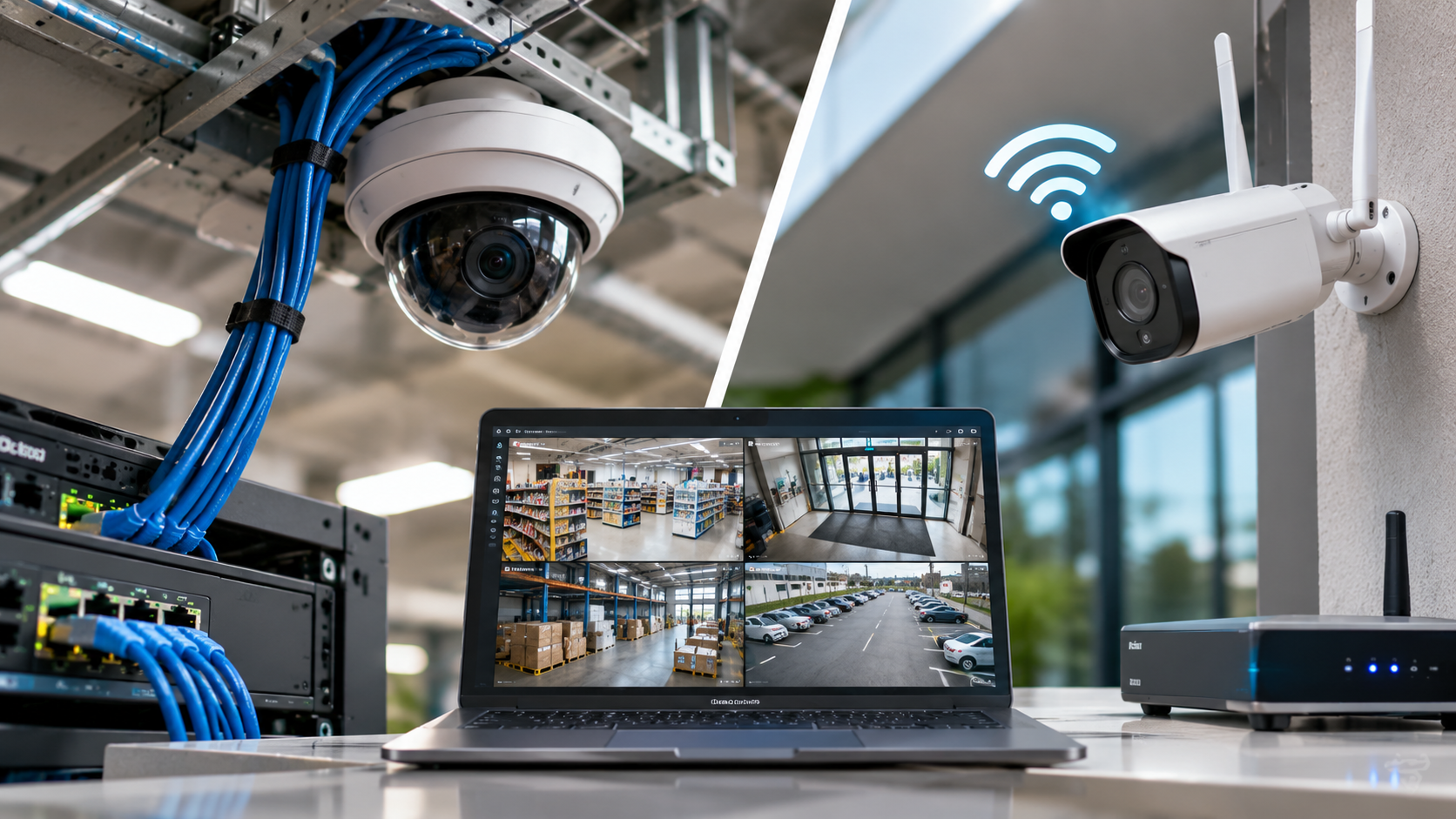
The primary difference between wired and wireless CCTV systems is how cameras transmit video data to recording equipment or a network.
A wired CCTV system uses physical cabling to connect cameras to a recorder, network switch, or other infrastructure. Depending on the system, this may involve coaxial cable or Ethernet cabling.
A wireless CCTV system transmits video over a wireless network, typically through Wi-Fi, instead of relying on a dedicated video cable between each camera and the recording system.
However, wireless does not always mean completely cable-free. Many wireless cameras still require a power connection, while others use rechargeable batteries or solar-assisted power.
Wired vs. Wireless at a Glance
| Feature | Wired CCTV | Wired CCTV |
| Video transmission | Physical cable | Wi-Fi or another wireless connection |
| Camera power | Cable, PoE, or separate power source | Often a power adapter, battery, or solar-assisted source |
| Installation | Requires cable routing | Requires wireless coverage and camera mounting |
| Connection stability | Generally consistent when properly installed | Can be affected by signal quality and interference |
| Bandwidth | Dedicated or shared wired network capacity | Uses available wireless network capacity |
| Flexibility | Camera locations depend partly on cabling access | Greater flexibility within wireless coverage |
| Maintenance | Cable and connection inspections | Network, power, battery, and signal checks |
| Best suited for | Permanent installations and larger commercial systems | Locations where cabling is difficult or impractical |
The distinction is important because wired and wireless systems are not necessarily different in camera technology. Both can use IP cameras, network video recorders (NVRs), and modern video management platforms. The primary difference is the connection method.
How Wired CCTV Systems Work
A wired CCTV system connects cameras to the recording or network infrastructure using physical cables.
In an IP-based system, cameras commonly connect to a network switch through Ethernet cabling. Power over Ethernet (PoE) can provide both network connectivity and electrical power through the same cable.
In traditional analog systems, cameras may connect to a digital video recorder (DVR) using coaxial cable, sometimes with separate power wiring.
Common Components of a Wired CCTV System
-
Security cameras: Capture video from designated areas.
-
Ethernet or coaxial cabling: Carries video signals or network data between cameras and other equipment.
-
Network switches: Connect IP cameras to the network. PoE switches can also supply camera power.
-
NVR or DVR: Records and manages video footage, depending on the camera system.
-
Storage: Provides space for recorded footage.
-
Network infrastructure: Supports remote viewing, system communication, and integration with other business technology.
Advantages of Wired CCTV Systems
1. More Consistent Connection
Wired cameras do not depend on Wi-Fi signal strength to transmit video. A properly installed cable connection provides a predictable communication path between the camera and the network.
This can be especially important in commercial environments where continuous monitoring is required.
2. Better Support for High-Resolution Video
Wired network connections can provide reliable bandwidth for high-resolution video streams, depending on the Ethernet standard, network equipment, and overall system design.
This is useful when businesses deploy multiple cameras that record continuously or capture detailed footage across large areas.
3. Centralized Power Through PoE
Power over Ethernet simplifies installation by allowing compatible cameras to receive power and transmit data through one Ethernet cable.
This reduces the need for separate power outlets at every camera location and can make centralized power management easier.
4. Less Dependence on Wireless Conditions
Wired systems are not directly affected by common Wi-Fi problems such as wireless interference, weak coverage, or competing wireless devices.
This makes them a practical option in environments with dense wireless activity or challenging building layouts.
5. Suitable for Permanent, Multi-Camera Installations
Businesses with established facilities and predictable camera locations can benefit from structured cabling and centralized network infrastructure.
Once installed, the cabling can provide a consistent foundation for long-term surveillance operations.
Disadvantages of Wired CCTV Systems
1. More Involved Installation
Wired systems require physical cable routing between camera locations and the network infrastructure. This may involve ceiling access, conduit installation, cable pathways, and coordination with other building systems.
Installation can become more complicated in occupied facilities or buildings with limited access to ceiling spaces.
2. Higher Initial Installation Costs in Some Facilities
The total cost may include cabling, labor, cable pathways, network equipment, and installation work.
Although wired systems can provide long-term value, facilities with difficult cable routes may require more extensive installation work.
3. Less Flexibility When Relocating Cameras
Moving a wired camera may require extending, rerouting, or replacing cabling.
This can be a consideration for businesses that frequently change store layouts, relocate equipment, or modify facility operations.
4. Physical Cable Damage Can Affect Connectivity
Cables can be damaged by construction work, environmental conditions, improper handling, or accidental disconnection.
Proper cable protection, labeling, testing, and documentation help reduce these risks.
How Wireless CCTV Systems Work
Wireless CCTV systems transmit video through a wireless connection rather than a dedicated video cable between each camera and the recording infrastructure.
Most commercial wireless IP cameras use Wi-Fi to communicate with a wireless access point or network gateway. Video can then travel across the network to an NVR, server, or cloud-based platform, depending on the system design.
Wireless cameras still need a reliable power source unless they are specifically designed for battery or alternative power operation.
Common Components of a Wireless CCTV System
-
Wireless security cameras: Capture video and transmit it through a wireless connection.
-
Wireless access points: Provide Wi-Fi connectivity for cameras within their coverage areas.
-
Network infrastructure: Routes video data between cameras, recording systems, and authorized users.
-
NVR or cloud platform: Stores and manages recorded footage.
-
Power source: Supplies electricity through an adapter, battery, or supported alternative power system.
Advantages of Wireless CCTV Systems
1. More Flexible Camera Placement
Wireless cameras can be installed in locations where running network cabling is difficult or expensive, provided there is sufficient wireless coverage and a suitable power source.
This flexibility can be useful for temporary monitoring areas, existing buildings, and locations where construction work needs to be minimized.
2. Potentially Faster Installation
When adequate wireless infrastructure and power are already available, wireless cameras may require less cabling work.
This can reduce installation complexity in certain environments.
3. Easier Camera Relocation
Wireless cameras can often be repositioned without installing a new data cable, provided the new location has adequate wireless coverage and power.
This can benefit facilities with changing layouts or evolving surveillance requirements.
4. Useful for Difficult-to-Reach Areas
Some locations may be challenging to access with traditional cabling. Wireless connectivity can provide another option for extending surveillance coverage.
However, signal strength, obstructions, and power availability must still be evaluated.
5. Reduced Data-Cabling Requirements
Wireless systems can reduce the amount of data cabling needed for individual cameras. This does not eliminate all infrastructure requirements, since access points, recording equipment, and power sources still need to be installed and maintained.
Disadvantages of Wireless CCTV Systems
1. Wireless Interference Can Affect Performance
Wireless cameras share radio frequency spectrum with other devices and networks. Interference from nearby access points, neighboring businesses, electronic equipment, and other wireless devices can affect connection quality.
A wireless site survey can help identify potential interference and coverage issues before deployment.
2. Performance Depends on Signal Strength
Walls, metal shelving, concrete, building materials, and long distances can weaken wireless signals.
A camera may appear to connect successfully but still experience inconsistent performance when signal quality is poor.
3. Bandwidth Can Become a Limitation
Multiple cameras transmitting high-resolution video can consume significant wireless network capacity.
Businesses must account for camera count, video resolution, frame rates, recording requirements, and other network traffic when planning a wireless surveillance system.
4. Power Still Needs to Be Addressed
Wireless video transmission does not eliminate the need for electricity.
Cameras that rely on batteries require periodic charging or replacement. Cameras using power adapters still need access to an appropriate power source.
5. Additional Network Security Considerations
Wireless camera systems require properly configured network security. Weak passwords, outdated firmware, insecure wireless settings, and poor network segmentation can create vulnerabilities.
Businesses should use strong authentication, encryption, firmware updates, and appropriate network access controls.
Wired vs. Wireless CCTV: Key Factors to Consider
The best CCTV configuration depends on more than the connection method. Businesses should evaluate how each option performs within their actual operating environment.
1. Installation Cost
Wired systems may require more labor and materials when cable routes are difficult to access. Wireless systems can reduce data-cabling requirements but may require additional access points, wireless upgrades, and power infrastructure.
| Cost Factor | Wired CCTV | Wireless CCTV |
| Camera cabling | Usually required | May be reduced or eliminated |
| Network equipment | Switches and other network hardware | Access points and network hardware |
| Power requirements | PoE or separate power | Separate power, battery, or supported alternative |
| Installation labor | Can be higher when cable routing is complex | Can be lower when coverage and power are available |
| Ongoing maintenance | Cable and equipment inspections | Wireless performance, power, and equipment checks |
The lowest initial installation cost does not always represent the best long-term investment. Businesses should compare the total cost of ownership, including installation, maintenance, equipment replacement, and future expansion.
2. Reliability and Network Performance
For permanent commercial installations, wired connections generally provide more predictable connectivity because they are not dependent on wireless signal conditions.
Wireless systems can also perform reliably when properly designed, but they require careful planning of access point placement, coverage, interference, and available bandwidth.
For either system, the recording equipment, network switches, power supply, and storage configuration must be properly designed.
3. Video Quality and Bandwidth
Video quality depends on camera resolution, compression, frame rate, and available network capacity.
High-resolution cameras and continuous recording can create significant bandwidth requirements, particularly when multiple cameras transmit simultaneously.
Wired Ethernet connections can provide dedicated physical connectivity to network switches. Wireless systems must share available radio capacity among connected devices.
Businesses should calculate expected bandwidth requirements before selecting equipment or finalizing the network design.
4. Security
Both wired and wireless CCTV systems require cybersecurity measures.
A wired connection does not automatically make a camera system secure. Unauthorized network access, vulnerable devices, and improperly configured recording equipment can still expose surveillance systems to risk.
Wireless systems introduce additional considerations related to Wi-Fi authentication, encryption, and signal access.
Recommended security practices include:
-
Change default camera and equipment credentials.
-
Use strong, unique passwords.
-
Keep camera and network equipment firmware updated.
-
Use appropriate network segmentation for surveillance devices.
-
Restrict access to recording systems and video feeds.
-
Disable unnecessary services and remote access features.
-
Monitor connected devices and investigate unusual network activity.
5. Scalability and Future Expansion
Businesses planning to expand surveillance coverage should consider how easily additional cameras can be integrated.
Wired systems can scale effectively when sufficient network switch capacity, cabling pathways, and power budgets are available.
Wireless systems can offer flexibility when adding cameras, but expansion may require additional access points or wireless capacity.
For multi-location businesses, standardized equipment, installation procedures, and network configurations can make future deployments easier to manage.
Can Businesses Use a Hybrid CCTV System?
Yes. A hybrid CCTV system combines wired and wireless cameras within the same surveillance environment.
This approach allows businesses to use wired connections where permanent infrastructure is practical while using wireless cameras in locations where cabling is difficult or unnecessary.
For example, a retail facility might use wired PoE cameras throughout the sales floor, stockroom, and loading area, while using a wireless camera in a separate area with adequate Wi-Fi coverage and power.
When a Hybrid System Makes Sense
-
Existing buildings have a mixture of accessible and difficult-to-reach camera locations.
-
Some cameras require consistent wired connectivity for high-volume video transmission.
-
Temporary or flexible monitoring locations are part of the security plan.
-
Businesses want to use existing cabling while expanding coverage.
-
Different areas have different infrastructure and operational requirements.
A hybrid system still requires coordinated network design. Wireless cameras must have adequate coverage, while wired cameras need properly planned cabling and switch capacity.
How to Choose the Right CCTV System for Your Business
Before selecting a wired, wireless, or hybrid system, businesses should evaluate the facility and its operational requirements.
The following considerations can help guide the decision.
| Evaluation Factor | Questions to Ask |
| Facility layout | Are camera locations accessible for cable installation? |
| Building materials | Could walls, ceilings, or metal structures affect wireless signals? |
| Camera count | How many cameras are required now and in the future? |
| Video requirements | What resolution, frame rate, and recording duration are needed? |
| Network capacity | Can the existing infrastructure support the additional video traffic? |
| Power availability | Are suitable power sources available at every camera location? |
| Security requirements | What access controls and network protections are required? |
| Future expansion | Will the business add cameras or modify its facility layout? |
| Budget | What are the initial installation and ongoing operating costs? |
General Recommendations by Business Environment
| Business Environment | Potentially Suitable Approach | Key Consideration |
| Retail stores | Wired or hybrid | Consistent coverage across sales floors, stockrooms, and entrances |
| Warehouses | Wired or hybrid | Long distances, metal structures, and wireless coverage |
| Corporate offices | Wired or hybrid | Existing network infrastructure and building layout |
| Quick-service restaurants | Wired or hybrid | Coverage of dining areas, kitchens, entrances, and service zones |
| Temporary facilities | Wireless, where practical | Deployment flexibility and available power |
| Large commercial facilities | Wired or hybrid | Network capacity, centralized management, and scalability |
These are general planning considerations, not fixed rules. A site assessment is necessary to determine the most appropriate configuration for each facility.
Why Network Infrastructure Matters in CCTV Installation
Modern IP-based CCTV systems depend on network infrastructure to transmit video, connect cameras, support recording equipment, and enable authorized remote access.
Even a high-quality camera may deliver inconsistent results when the supporting network is poorly designed.
Important infrastructure considerations include:
Structured Cabling: Properly installed Ethernet and fiber cabling provide the physical connections needed to support cameras, network switches, and other equipment. Read more about best practices for low-voltage installation projects.
Network Switches and PoE Capacity: Businesses must ensure that switches have sufficient port capacity and power budgets to support connected cameras.
Wireless Coverage: Wireless CCTV installations require appropriate access point placement and sufficient signal strength. A Wi-Fi site survey can help evaluate coverage and potential interference.
Bandwidth Planning: Network infrastructure must accommodate video traffic alongside existing business applications. Learn more about network infrastructure for businesses.
Power and Backup: Camera systems and network equipment need dependable power. UPS equipment and appropriate power planning can help maintain critical infrastructure during certain power interruptions. See our guide to power requirements for modern network and security systems.
Installation Standards and Documentation: Consistent cable labeling, equipment identification, testing, and closeout documentation make systems easier to maintain and troubleshoot.
How Prime-Net Supports Commercial CCTV Installation
Prime-Net provides technology deployment and installation services for multi-site retail and commercial environments. Its capabilities include CCTV installation, network infrastructure, wireless networks, and project staffing.
For commercial surveillance deployments, the supporting installation work can include:
-
CCTV camera installation and associated cabling.
-
Network infrastructure installation supporting surveillance equipment.
-
Wireless network installation where required by the system design.
-
Coordination of equipment installation across multiple locations.
-
Project management and field execution support.
-
Installation verification, quality assurance, and closeout documentation.
Prime-Net follows a structured deployment approach:
- Survey: Review site conditions, installation requirements, and infrastructure readiness.
- Staging: Coordinate equipment and materials ahead of field deployment.
- Installation: Execute the planned camera, cabling, and network infrastructure work.
- Quality Assurance: Verify installation quality and address identified issues.
- Turnover: Complete documentation and handoff requirements.
For businesses planning CCTV installations across multiple facilities, standardized processes and centralized project coordination can help maintain consistency from one location to another.
Frequently Asked Questions
Is wired CCTV better than wireless CCTV?
Neither option is universally better. Wired CCTV generally provides more predictable connectivity and is well suited to permanent installations. Wireless CCTV offers greater flexibility where running data cables is difficult. The best choice depends on facility conditions, network requirements, and budget.
Do wireless CCTV cameras need electricity?
Most wireless CCTV cameras still require power. They may use a power adapter, rechargeable battery, or another supported power source. Wireless generally describes how video data is transmitted, not how the camera receives electricity.
Can wireless CCTV cameras work without Wi-Fi?
Some wireless camera systems use dedicated wireless technologies or point-to-point connections rather than standard Wi-Fi. However, many commercial wireless IP cameras rely on a Wi-Fi network. The required connection depends on the camera and recording system.
Are wired CCTV cameras more secure?
A wired connection does not automatically make a CCTV system secure. Both wired and wireless systems require strong credentials, updated firmware, appropriate network segmentation, and controlled access to video feeds and recording equipment.
Can wired and wireless CCTV cameras work together?
Yes. Many modern surveillance environments support a combination of wired and wireless IP cameras. Compatibility depends on the camera protocols, recording platform, network configuration, and equipment specifications.
How much bandwidth do CCTV cameras use?
Bandwidth requirements depend on camera resolution, frame rate, compression settings, and the number of cameras transmitting simultaneously. High-resolution cameras and continuous video streams generally require more network capacity. Businesses should calculate expected traffic before deployment.
Should CCTV cameras use a separate network?
For many commercial environments, placing surveillance devices on a dedicated VLAN or appropriately segmented network is a useful security and traffic-management practice. The specific configuration should align with the organization’s IT policies and network architecture.
Final Thoughts
Choosing between wired and wireless CCTV systems requires a clear understanding of the facility, security objectives, and supporting network infrastructure.
Wired systems are often a strong choice for permanent commercial installations that require predictable connectivity and centralized infrastructure. Wireless systems provide flexibility in locations where running data cables is difficult or impractical. Hybrid configurations can combine the advantages of both.
Regardless of the approach, reliable surveillance depends on more than the cameras themselves. Proper network planning, power availability, installation quality, cybersecurity, and documentation all contribute to long-term system performance.
Prime-Net supports commercial technology deployments through CCTV installation, network infrastructure, wireless networks, and coordinated project execution.
Planning a commercial CCTV installation or multi-location surveillance deployment? Contact Prime-Net at info@prime-net.net to discuss your project requirements.