Network downtime can interrupt business operations, delay transactions, disrupt communication, and affect customer experiences. For businesses that depend on connected systems, even a short network interruption can create operational challenges.
While network outages can result from many factors, some problems begin long before a network goes live. Poor cable installation, incorrect equipment configuration, inadequate testing, and incomplete documentation can create weaknesses that lead to recurring connectivity issues.
Proper network installation helps reduce these risks by establishing a reliable infrastructure from the beginning. It ensures that cables, network devices, power requirements, and connections are installed and verified according to the project’s technical requirements.
For commercial facilities and businesses operating across multiple locations, installation quality is especially important. A consistent approach helps reduce avoidable issues and supports dependable network performance over time.
This article explores how proper installation prevents network downtime, the common installation mistakes that affect reliability, and the practices businesses should prioritize when deploying network infrastructure.
Why Proper Network Installation Matters
A business network depends on multiple components working together. These may include structured cabling, switches, routers, wireless access points, firewalls, power systems, and connected devices.
If one component is installed incorrectly, it can affect the performance or availability of other parts of the network.
For example, a poorly terminated Ethernet cable may cause intermittent connectivity. An improperly configured switch may prevent devices from communicating as expected. Insufficient power capacity may cause network equipment to restart or become unavailable.
These problems may not always appear during initial installation. Some emerge after equipment is under normal operating loads or when additional devices are connected.
Proper installation addresses these risks through planning, standardized procedures, testing, and verification before the infrastructure is handed over for operation.
8 Ways Proper Installation Helps Prevent Network Downtime
1. Proper Site Assessment Identifies Potential Problems Early
A successful installation begins with understanding the facility and its existing infrastructure.
Before work starts, technicians and project teams should evaluate the installation environment, identify equipment locations, review cable pathways, and confirm project requirements.
A site assessment can help identify:
- Existing network infrastructure and equipment.
- Available rack space and equipment mounting locations.
- Cable pathways and potential obstructions.
- Electrical outlets and power availability.
- Environmental conditions affecting network equipment.
- Wireless coverage requirements.
- Access restrictions and operational considerations.
Identifying these conditions early helps prevent installation delays, incorrect equipment placement, and avoidable rework.
For wireless deployments, a site survey can also help determine appropriate access point locations and identify potential signal interference. Businesses can learn more in our guide to the importance of Wi-Fi site surveys.
2. Structured Cabling Reduces Physical Connectivity Problems
Structured cabling provides the physical foundation for many commercial network installations.
Poor cable routing, improper termination, damaged cables, and inconsistent labeling can create connectivity problems that are difficult to diagnose.
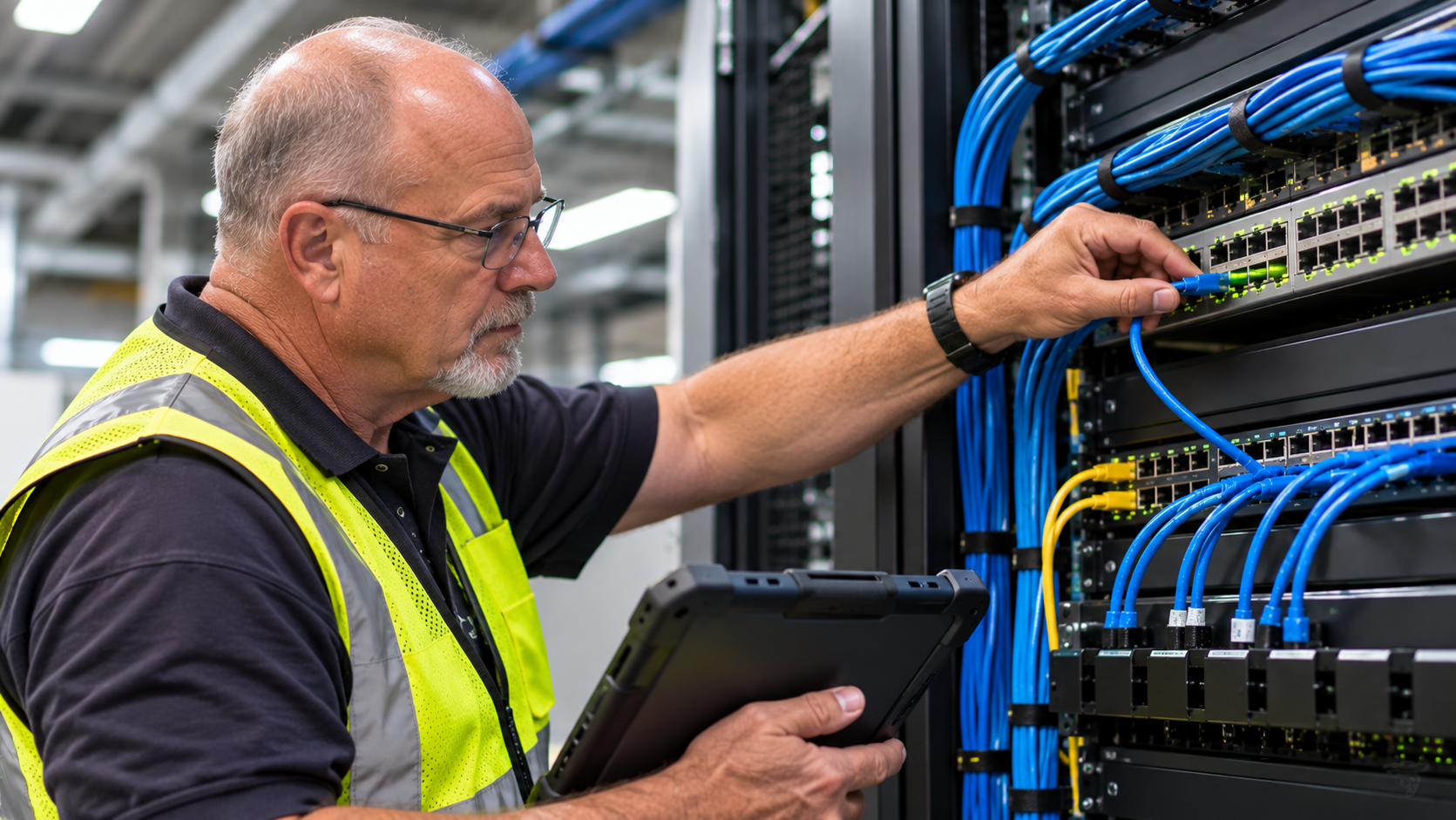
Proper cabling installation helps establish reliable connections between network devices and reduces the likelihood of physical-layer issues.
Important practices include:
- Use cable types appropriate for the application and required performance.
- Follow manufacturer specifications and applicable installation standards.
- Maintain appropriate separation from sources of electrical interference.
- Avoid excessive bending, tension, and compression.
- Use proper termination methods and compatible connectors.
- Label cables and ports consistently.
- Protect cabling from physical damage.
For larger facilities, organized cable pathways and clear identification also make future troubleshooting and expansion more manageable.
Related reading: Best Practices for Low-Voltage Installation Projects.
3. Correct Equipment Installation Supports Stable Network Operations
Network devices must be installed in appropriate locations and connected according to their technical requirements.
Switches, routers, access points, patch panels, and other equipment should be mounted securely, connected correctly, and provided with suitable environmental and power conditions.
Improper equipment installation can contribute to overheating, disconnected ports, poor cable management, and difficult maintenance access.
Consider the following installation practices:
| Equipment | Installation Considerations | Potential Risk if Installed Incorrectly |
| Network switches | Port capacity, mounting, ventilation, and power requirements | Connectivity interruptions and equipment instability |
| Routers | Correct placement, configuration, and WAN/LAN connections | Loss of network communication |
| Wireless access points | Placement, mounting, coverage, and power | Weak or inconsistent wireless connectivity |
| Patch panels | Proper termination, labeling, and cable organization | Misconnections and troubleshooting delays |
| Network racks | Equipment spacing, cable management, and ventilation | Difficult maintenance and heat-related issues |
| UPS systems | Appropriate capacity, connections, and battery condition | Loss of network availability during power interruptions |
Proper equipment placement and installation make the infrastructure easier to operate, inspect, and maintain.
4. Correct Configuration Prevents Avoidable Network Issues
Physical installation is only one part of a reliable network deployment. Equipment must also be configured correctly.
Incorrect settings can prevent devices from communicating, create conflicts, or expose network services to unnecessary risks.
Configuration requirements vary by project, but may include:
- IP addressing and subnet configuration.
- VLAN assignment and network segmentation.
- Switch port configuration.
- Router and gateway settings.
- Wireless network configuration.
- Authentication and access controls.
- Firmware and software updates.
- Integration with existing network systems.
Configuration should follow the approved network design and the client’s technical requirements.
For multi-site deployments, standardized configuration procedures are particularly useful. They help maintain consistency across locations and reduce the likelihood of site-specific errors.
5. Proper Power Planning Helps Prevent Equipment Interruptions
Network equipment depends on stable electrical power. An interruption or inadequate power supply can affect switches, routers, wireless access points, and other connected devices.
Power planning should account for the electrical requirements of the equipment being installed.
For example, Power over Ethernet (PoE) switches must have sufficient power budgets to support connected devices such as wireless access points and IP cameras.
Other considerations include:
- Total equipment power consumption.
- PoE capacity and connected-device requirements.
- UPS sizing and runtime requirements.
- Power distribution and circuit availability.
- Grounding and surge protection.
- Equipment restart and recovery behavior.
A properly selected UPS can help maintain power to critical network equipment during certain power interruptions, depending on its capacity and runtime.
For more detail, see our article on power requirements for modern network and security systems.
6. Testing and Verification Catch Problems Before Handover
Testing is one of the most important steps in preventing installation-related downtime.
A network should not be considered ready simply because the equipment is powered on and connected. Each installation should be checked against its requirements before turnover.
Testing may include:
| Test or Verification | Purpose |
| Cable continuity testing | Identifies open circuits, shorts, and wiring faults |
| Cable certification, where required | Verifies cabling performance against applicable standards |
| Port connectivity checks | Confirms that devices connect through the intended ports |
| Network connectivity testing | Checks communication between devices and network segments |
| PoE verification | Confirms that compatible devices receive appropriate power |
| Wireless validation | Evaluates coverage and connection performance |
| Equipment checks | Confirms installation, power, and operational status |
| Documentation review | Confirms that installation records are complete and accurate |
Testing helps identify problems while installation teams are still on-site and can address them more efficiently.
Without proper verification, issues may only become apparent after employees begin using the network or business operations depend on it.
7. Documentation Makes Troubleshooting Faster
When network problems occur, technicians need accurate information to identify the affected equipment, connections, and locations.
Incomplete or outdated documentation can increase troubleshooting time and make even simple repairs more complicated.
A proper installation closeout should include relevant records such as:
- Cable and port labels.
- Rack and equipment identification.
- Cable test results, where applicable.
- Network equipment inventory.
- Installation verification records.
- Updated network diagrams, when included in project scope.
- Identified exceptions or outstanding items.
- Project closeout documentation.
Consistent documentation is especially valuable for organizations managing multiple facilities. It gives internal IT teams and service providers a clearer understanding of the installed infrastructure.
8. Standardized Installation Procedures Improve Multi-Site Consistency
Businesses operating across multiple locations face an additional challenge: maintaining consistent network infrastructure from one facility to another.
Without standardized installation procedures, different sites may end up with inconsistent cable labeling, equipment placement, configuration practices, and documentation.
These differences can make maintenance more difficult and increase the time needed to resolve issues.
A standardized deployment approach helps establish consistent expectations for:
- Equipment installation and placement.
- Cable routing and labeling.
- Network connections and configuration.
- Testing and quality assurance.
- Installation documentation.
- Final turnover requirements.
For businesses planning network deployments across multiple locations, managing multi-site network installations successfully requires centralized coordination and consistent field execution.
Common Installation Mistakes That Can Cause Network Downtime
Many network problems can be traced to installation practices that were overlooked, rushed, or not properly verified.
The following table highlights common examples and their potential consequences.
| Installation Mistake | Possible Consequence | Recommended Prevention |
| Poor cable termination | Intermittent or failed connections | Follow proper termination procedures and test connections |
| Incorrect cable routing | Cable damage or interference | Plan pathways and maintain proper separation |
| Missing cable labels | Longer troubleshooting time | Use consistent labeling standards |
| Incorrect switch configuration | Devices may fail to communicate | Follow approved configuration requirements |
| Insufficient PoE capacity | Connected devices may not receive adequate power | Calculate total power requirements |
| Poor access point placement | Weak or inconsistent Wi-Fi coverage | Conduct a wireless site survey |
| Inadequate ventilation | Equipment may overheat | Follow equipment spacing and environmental requirements |
| Incomplete testing | Installation defects remain undetected | Verify connections and equipment before turnover |
| Incomplete documentation | Difficult maintenance and troubleshooting | Provide accurate closeout records |
Addressing these issues during installation is generally more efficient than diagnosing them after the network is already in operation.
The Role of Quality Assurance in Network Installation
Quality assurance helps confirm that completed installation work meets the project’s technical requirements and established standards.
It should be incorporated throughout the deployment process rather than treated as a final inspection alone.
A structured quality assurance process may include:
Pre-Installation Review
Confirm the scope of work, equipment requirements, site readiness, installation plans, and technical specifications.
Installation Monitoring
Verify that field work follows approved procedures and that identified issues are addressed during execution.
Post-Installation Testing
Check cable connections, equipment operation, network connectivity, and other requirements defined by the project.
Issue Resolution
Document deficiencies, assign corrective actions, and verify that identified issues have been resolved.
Final Turnover
Provide the required installation records, test results, and closeout documentation.
This approach helps ensure that the installed infrastructure is ready for its intended use before the project is handed over.
Why Proper Installation Matters for Multi-Site Businesses
For businesses with multiple stores, offices, clinics, or commercial facilities, network downtime at one location can disrupt local operations. Repeated installation issues across several locations can create a much larger operational burden.
A consistent deployment process helps reduce variations in installation quality and makes network infrastructure easier to support across the organization.
Multi-site projects benefit from:
- Centralized project management and scheduling.
- Standardized installation procedures.
- Consistent equipment and cabling practices.
- Coordinated field resources.
- Documented testing and quality assurance.
- Clear communication between project teams and stakeholders.
- Structured closeout and turnover.
The objective is not simply to complete installations at every location. It is to establish infrastructure that meets the required specifications and can be supported consistently after deployment.
How to Evaluate a Network Installation Partner
Choosing an installation partner is an important part of protecting network reliability.
Businesses should look beyond the number of technicians or the ability to complete physical installation work. A qualified partner should demonstrate a structured approach to planning, execution, testing, and project closeout.
Consider evaluating providers based on the following criteria:
| Evaluation Area | What to Look For |
| Technical capabilities | Experience with structured cabling, network infrastructure, and wireless installations |
| Project management | Centralized scheduling, communication, and deployment oversight |
| Field workforce | Trained technicians and appropriate project staffing |
| Installation standards | Consistent procedures and attention to technical requirements |
| Quality assurance | Defined verification and issue-resolution processes |
| Multi-site experience | Ability to coordinate work across multiple locations |
| Documentation | Organized testing records and project closeout |
A partner with established processes can help businesses maintain greater consistency throughout the installation lifecycle.
How Prime-Net Supports Reliable Network Deployments
Prime-Net provides nationwide technology deployment and installation services for multi-site retail and commercial environments.
Its capabilities include Point-of-Sale Installation, Wireless Networks, Network Infrastructure, CCTV Installation, Project Staffing, and Digital Menu Boards.
For network infrastructure projects, Prime-Net supports installation execution through centralized project management, a trained technician workforce, standardized field processes, and quality assurance.
Its deployment workflow follows five stages:
- Survey: Review site conditions, project requirements, and infrastructure readiness.
- Staging: Coordinate equipment and materials before field installation.
- Installation: Execute the required technology and infrastructure work.
- Quality Assurance: Verify completed work and address identified issues.
- Turnover: Complete documentation and project handoff requirements.
This structured approach supports consistent execution across individual sites and larger multi-location programs.
Whether a project involves network infrastructure, wireless networks, POS systems, or CCTV installations, proper planning and installation practices help establish the foundation for reliable business operations.
Frequently Asked Questions
Can poor network installation cause downtime?
Yes. Improper cable termination, incorrect equipment configuration, insufficient power capacity, and incomplete testing can contribute to network interruptions. Proper installation helps identify and reduce these risks before the infrastructure becomes operational.
What is the most important step in preventing network installation problems?
There is no single step that addresses every risk. Proper site assessment, installation planning, standardized execution, testing, and documentation work together to improve installation quality and reduce avoidable problems.
Why is cable testing important after network installation?
Cable testing helps identify wiring faults and verify that installed connections meet the required specifications. It can catch problems before connected devices depend on those connections during normal operations.
Does proper installation guarantee zero network downtime?
No. Even a properly installed network can experience outages caused by power failures, equipment defects, software issues, service-provider interruptions, cyber incidents, or other external factors. Proper installation reduces avoidable infrastructure-related risks but cannot eliminate every possible cause of downtime.
How does network documentation help prevent downtime?
Accurate documentation helps technicians identify equipment, trace connections, understand network layouts, and troubleshoot problems more efficiently. It also supports future maintenance, upgrades, and expansion.
Why are standardized installation procedures important for multi-site deployments?
Standardized procedures help ensure that equipment, cabling, testing, and documentation follow consistent requirements across locations. This makes infrastructure easier to maintain and reduces differences in installation quality.
How often should businesses inspect their network infrastructure?
Inspection frequency depends on the facility, equipment, operational requirements, and maintenance policies. Businesses should follow manufacturer recommendations and internal IT procedures while reviewing infrastructure after major changes, renovations, or recurring connectivity issues.
Final Thoughts
Network downtime can have many causes, but installation quality is one area businesses can address before their infrastructure goes live.
Proper site assessment, structured cabling, correct equipment installation, power planning, configuration, testing, and documentation all contribute to a more dependable network foundation.
For multi-site businesses, standardized procedures and coordinated project execution are equally important. They help maintain consistency across locations and make infrastructure easier to support over time.
Prime-Net supports commercial technology deployments through network infrastructure installation, wireless networks, POS installation, CCTV installation, and coordinated field execution.
Planning a network installation or multi-location technology deployment? Contact Prime-Net at info@prime-net.net to discuss your project requirements.